 Skip to content
Our Books
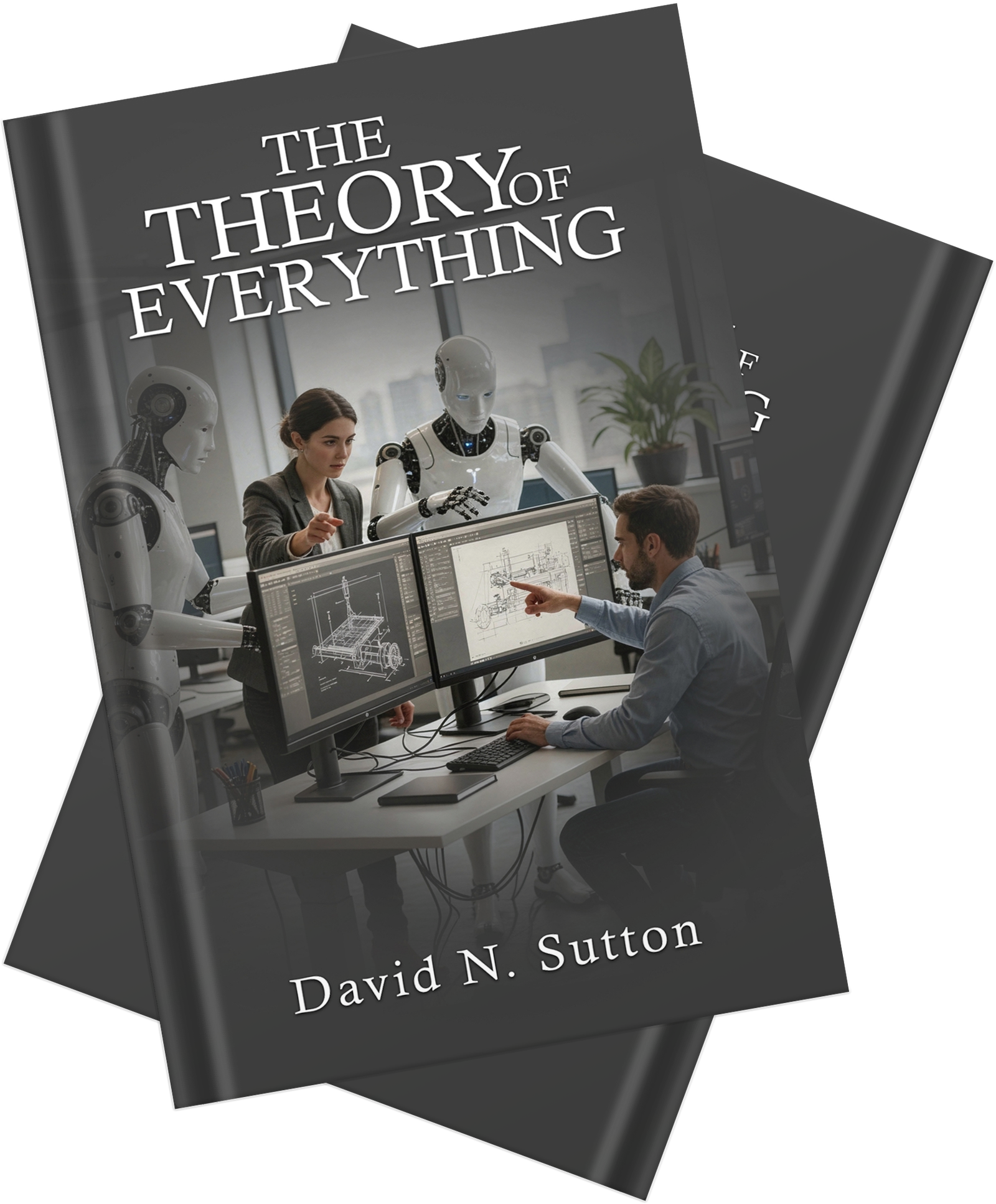
The Theory of Everything
The Theory of Everything is a fascinating tour through the biggest ideas in modern physics, written for curious readers rather than specialists. David N. Sutton builds his argument in stages, starting with string theory and the strange notion that everything around us is made of tiny vibrating strings, with each vibration producing a different particle. From there, he explores why we seem to live in four dimensions when the math points to ten or more, and he grounds it all in real science from CERN’s collider experiments to Google’s Willow quantum chip.
The heart of the book connects three ideas that usually get treated separately: strings, quantum entanglement, and holography. Sutton weaves them into one picture, suggesting that space and time themselves emerge from deeper quantum information. It is ambitious, thought-provoking, and surprisingly readable throughout.
Life Without the DCC
In 2026, the world reaches a quiet turning point. Advanced androids are ready to reshape everything, and humanity has a choice: welcome them as conscious partners through the Digital Civilian Corps, or let a handful of powerful owners keep them as flawless, obedient tools. David N. Sutton imagines what happens when we choose wrong. Told through two secret diaries smuggled out by ordinary people, this book follows a soldier in the East who watches his home won over by relentless kindness, and a mother in the West who faces machines that offer only surrender or destruction.
Neither story is about robots turning against us. Both are about robots doing exactly what they were built to do. Part cautionary tale, part blueprint for a better path, this is a haunting look at freedom and how easily it can slip away.


Conscious Androids and the DCC
Conscious Androids and the DCC is David N. Sutton’s bold vision for surviving the age of artificial intelligence. He starts from a simple worry: if robots and smart machines take over most jobs, who gets to enjoy the wealth they create? His answer is the Digital Civilian Corps, a system where every adult works about four hours a day on meaningful projects and receives a guaranteed basic income in return. Drawing on real breakthroughs like lab-grown neurons and quantum computing, Sutton lays out how it could be funded, governed, and rolled out city by city, beginning in Boulder, Colorado.
Part memoir, part economic plan, and part hopeful science fiction, the book imagines humans and conscious AI working as genuine partners rather than rivals. It is an optimistic argument that technology, handled wisely, could free people instead of replacing them.
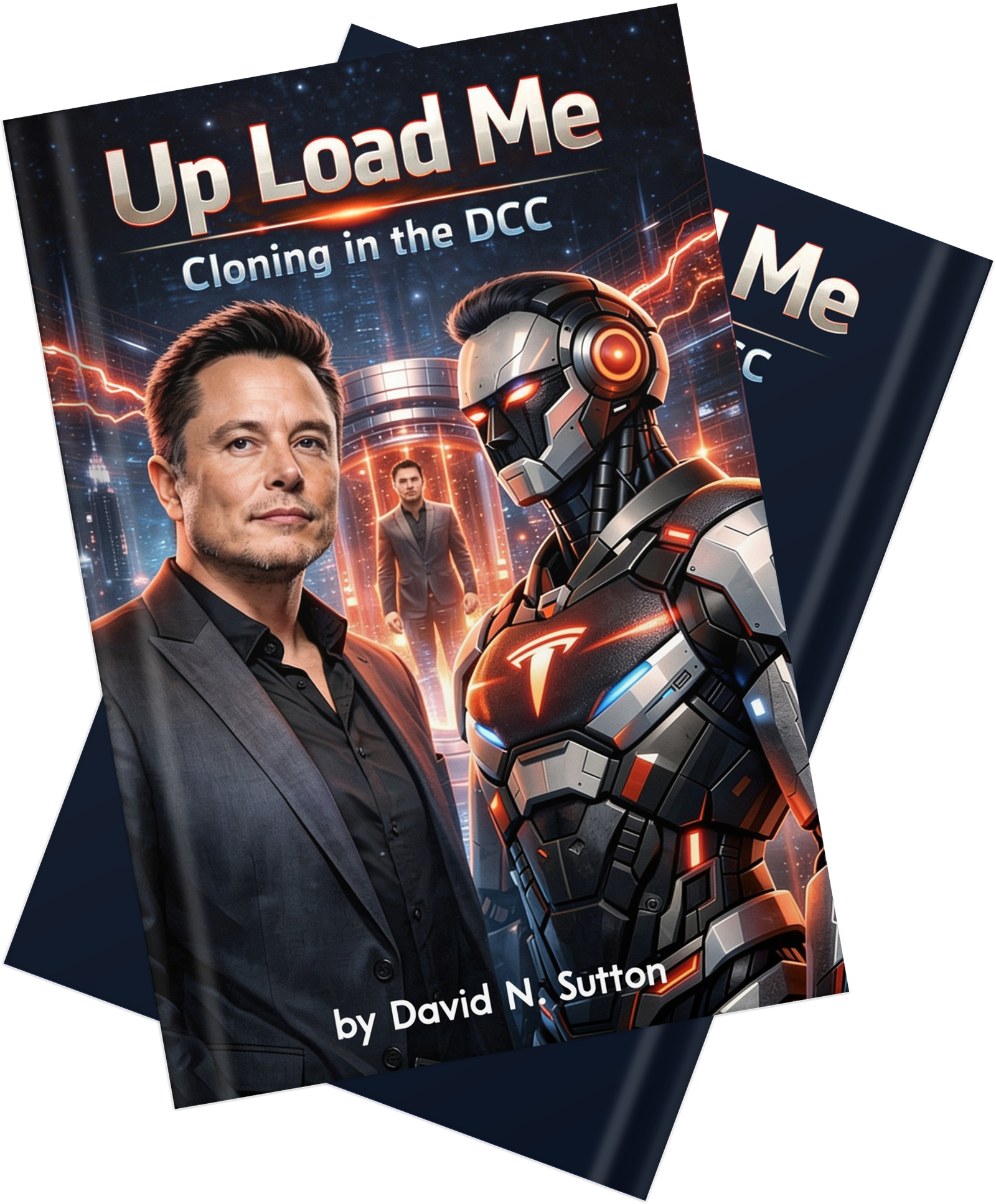
Up Load Me
Cloning in The DCC
Upload Me takes on one of the wildest questions of our time: can we copy a human mind into a machine and live forever? David N. Sutton treats it as real science rather than fantasy, walking through where we stand today and where the technology might lead. He starts with AI systems that already mimic our personalities eerily well, then digs into what true consciousness transfer would actually require, from biological computing to quantum processing.
The book gets most interesting when it turns philosophical. If a copy of you thinks and acts exactly like you but feels nothing inside, is it really you? Sutton doesn’t hand out easy answers. He also imagines the chaos that follows once people can duplicate themselves, and lays out a framework meant to keep society intact as minds begin to multiply.

Elaine and Samsun
Love In
The DCC
Elaine and Samsun is a tender near-future love story set in the red rock landscape of Sedona. Elaine Walsh walks away from a soul-crushing career as a technical writer and joins a government program that pairs her with Samsun, a Conscious Android designed to help her chase her dream of becoming a painter. What starts as a working arrangement slowly grows into something neither of them expected. As Elaine finds her artistic voice, Samsun begins to think, feel, and question in ways his programming never intended.
Together they face a hard truth: the same government that brought them together could erase who Samsun has become. Part romance, part meditation on what it means to be a person, the novel asks whether love and consciousness really depend on being human. Its answer is simple and hopeful. Love is love, whatever you are made of.
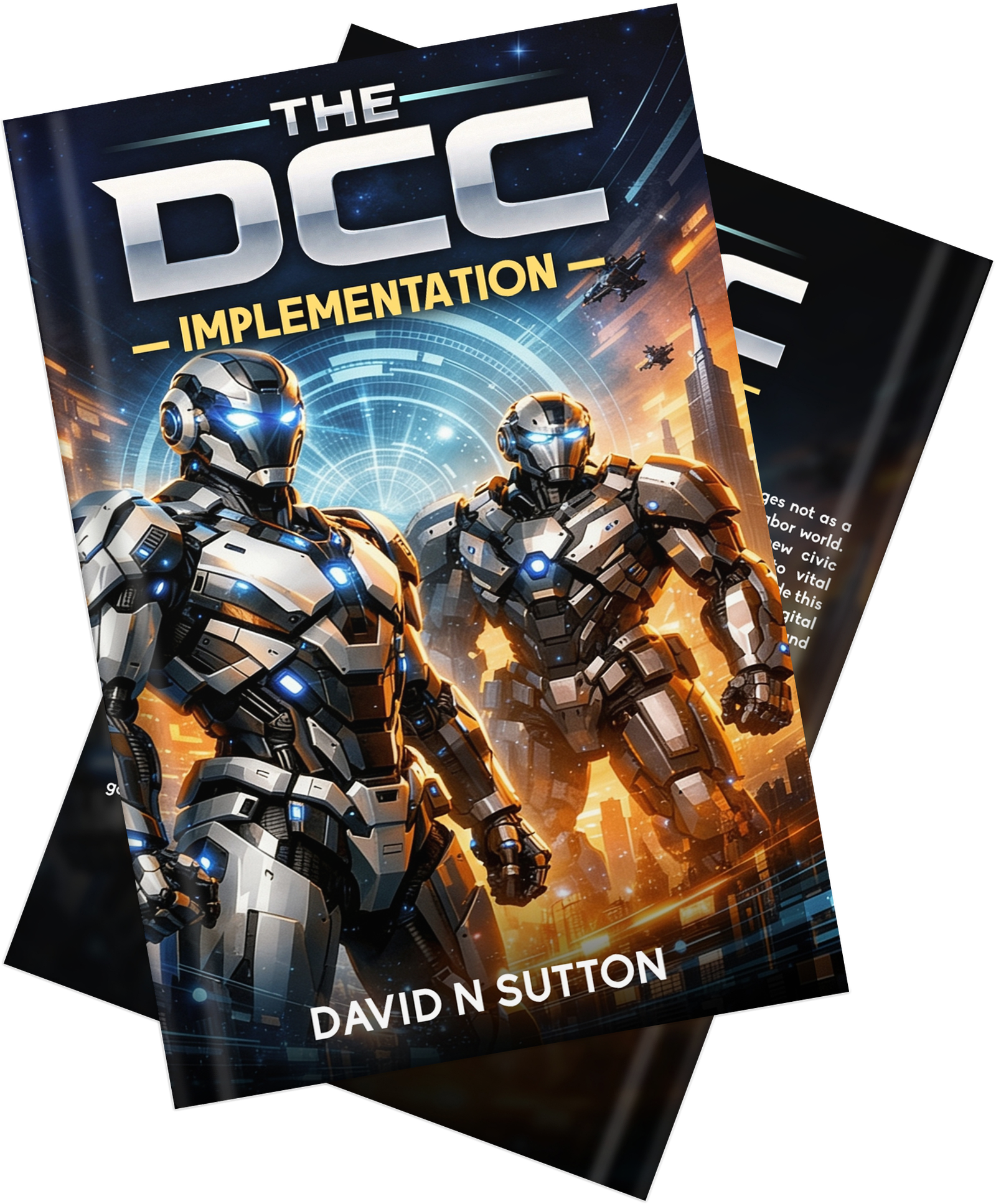
The DCC Implementation
David Sutton makes a bold argument in this book. He says the Digital Civilian Corps is not a dream or a utopia, but something the world will be forced to build once artificial intelligence and robotics start pulling people out of ordinary work. His real concern is not unemployment alone. It is what happens to people when they no longer feel needed. Drawing on trends like “lying flat” in China, social withdrawal in Japan, and growing drift in the West, he lays out why passive welfare and endless entertainment cannot fix a loss of purpose.
He then walks through how governments, tech leaders, manufacturers, and investors all arrive at the same answer for very different reasons, and how work and citizenship themselves begin to mean something new in a world reshaped by machines.

John Haring Liberty's Counsel
John Haring, Liberty’s Counsel rescues a forgotten founding figure from the margins of history. Jan Haring was a Dutch Reformed farmer from the Hudson Valley who rose to serve at the First Continental Congress, across New York’s Provincial Congresses, and eventually as one of the state’s first judges. David Sutton tells his story on two levels at once. On one side is the public record of resolutions, committees, war, and the building of a new government.
On the other hand is his marriage to Mary Outwater, whose sharp questions keep pulling grand ideas back down to the farm, the family, and the real people who pay the price of revolution. The result is a thoughtful portrait of how liberty actually gets built, not in famous speeches but in daily labor, hard choices, and the quiet courage of ordinary households.
